
Teide Casts a Triangular Shadow That Reaches La Gomera. Here's What You Actually See at Sunset.
There's a moment, in the last fifteen minutes before the sun disappears into the Atlantic, when Teide does something that's difficult to put into words. It casts its shadow onto the ocean. A perfect geometric triangle, dozens of kilometres long, stretching all the way to La Gomera.
Teide is the highest mountain in Spain: 3,718 metres. But what truly matters when talking about the sunset isn't the altitude itself. It's the shape. A volcanic rock pyramid rising out of the Atlantic, isolated, with nothing of similar height around it. As the sun drops low, the shadow is cast laterally across the ocean, and by perspective effect the shadow corridor appears to converge towards a point on the horizon, forming a triangle visible to the naked eye. No photograph really captures it. It's one of those phenomena you have to see in person.
Our quad tour departs from the coast, where in July temperatures comfortably reach 30 to 33 degrees and climbs to 2,200 metres. On that journey you pass through virtually every climate zone the island offers in about ninety minutes. The vegetation changes, the light changes, and at a certain point clouds appear. But below you, not above.
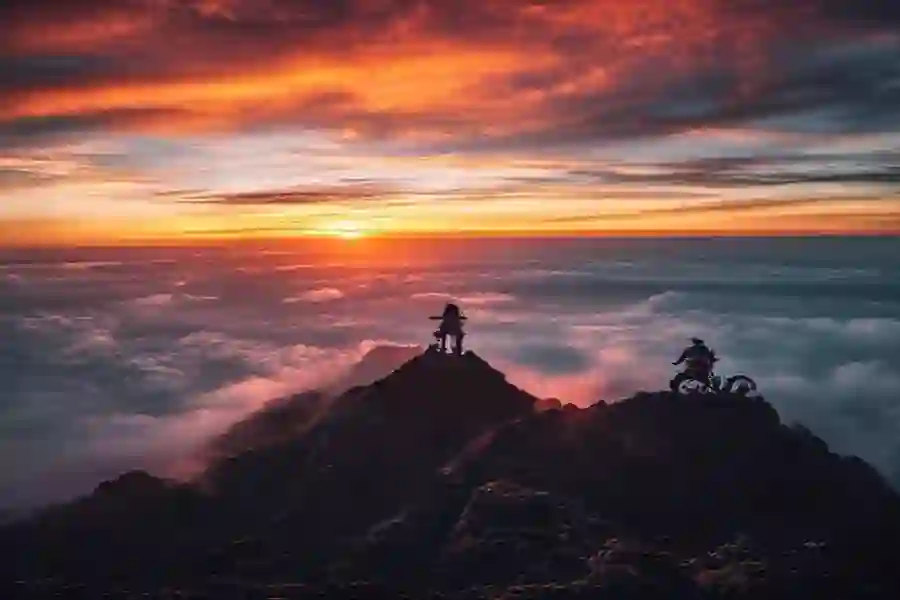
The sea of clouds is the phenomenon that surprises most people ascending for the first time. Atlantic trade winds push moisture against the island's slopes and clouds accumulate between 600 and 1,800 metres altitude. Teide is too tall for them. It blocks them. You find yourself above a white layer covering the sea and the coastal plain below, and the sun sets in a completely clear sky. The colours in those final twenty minutes, bright orange, deep red, then violet, then darkness, are unlike any sunset you can see from the beach.
A practical note we always make sure to give: at altitude it's between 15 and 17 degrees even in midsummer. Anyone who goes up in beach wear spends the most beautiful minutes of the evening shivering. Bring a warm layer.
We depart in the late afternoon. Sunset in July is around 9:15pm, so there's plenty of time to climb at a comfortable pace, enjoy the afternoon light on the lava landscape, and wait for that final half hour when Teide stops being a mountain and becomes something harder to categorise.
Stay a little longer after sunset and you get a second show: Teide's sky is among the darkest in Europe, perfect for stargazing.
Want to experience the Teide sunset? Chat with us on WhatsApp.
Book the Quad Tour